
Professional Foundations
If You Don't Answer Your Phone, Someone Else Will.
📖 Difficulty: Beginner
⏱ Estimated Reading Time: 8–10 Minutes
🎯 Lesson Objective:
Understand why answering your phone remains one of the most overlooked fundamentals of professional real estate and how one missed call can become someone else's commission.
✅ Expected Outcomes
- Build stronger client trust
- Create a more professional reputation
- Respond with confidence
- Capture more business from opportunities you already have
Let's Start With An Uncomfortable Truth...
There are thousands of books about lead generation.
Thousands more about social media, artificial intelligence, CRM systems, funnels, Instagram, TikTok, YouTube, email campaigns, personal branding, video marketing, and enough “secret systems” to fill a warehouse.
Yet some agents spend thousands of dollars trying to make their phone ring...
...then let it go to voicemail.
Read that again.
You paid money to make the phone ring.
Then ignored the person trying to hire you.
💡 Learning Point
Professionalism isn't demonstrated when it's convenient.
It's demonstrated through consistent habits.
Why This Matters
Real estate isn't about houses.
It's about people.
And people almost never call because they're bored.
They're calling because they have a question, a problem, an opportunity, or they need someone they can trust.
When they finally decide to call a real estate professional, answering the phone is often your first opportunity to demonstrate exactly that.
Professionalism.
Professionalism Isn't About Choosing One Client Over Another
One of the biggest misconceptions in real estate is that answering your phone means dropping everything you're doing.
It doesn't.
In fact, sometimes the most professional thing you can do is not immediately engage the caller.
Here's why.
As a real estate professional, you have a fiduciary obligation to the clients you've already committed to representing.
When a buyer or seller is in the middle of a transaction, they become your highest priority.
They've entrusted you with one of the largest financial decisions they'll ever make, and that responsibility isn't something to take lightly.
So what happens when you're sitting with another prospective client and your phone rings?
This is where many agents see an interruption.
I see an opportunity.
An opportunity to demonstrate professionalism.
Simply smile and say:
“Would you excuse me for about thirty seconds? I'm expecting a call from a client who's currently under contract. I always answer when one of my active clients needs me.”
Answer the phone.
If it's an emergency, handle it.
If it isn't, politely say:
“I'm currently meeting with another client. Is everything okay? If this can wait fifteen or twenty minutes, I'll call you as soon as we're finished.”
Then hang up.
Turn your attention back to the person sitting across from you.
Now comes the most important part of the lesson.
Don't pretend nothing happened.
Use it as a teaching moment.
Simply explain:
“I apologize for the interruption. That was one of my clients who's currently under contract. During a transaction, my clients become my highest priority.”
Pause.
Then add one final sentence.
“And if we decide to work together, you'll receive that exact same level of service.”
💡 Learning Point
You didn't just tell a prospective client you provide excellent service.
You demonstrated it.
People believe what they witness far more than what they hear.
That's what professionalism looks like.
Not perfect timing.
Not never missing a call.
Not juggling ten conversations at once.
Professionalism is managing expectations, honoring your fiduciary responsibilities, and treating every client with the same level of respect you'd expect if the roles were reversed.
Remember, today's prospective client is watching how you treat someone else.
If they like what they see, they'll expect the same treatment when it's their turn.
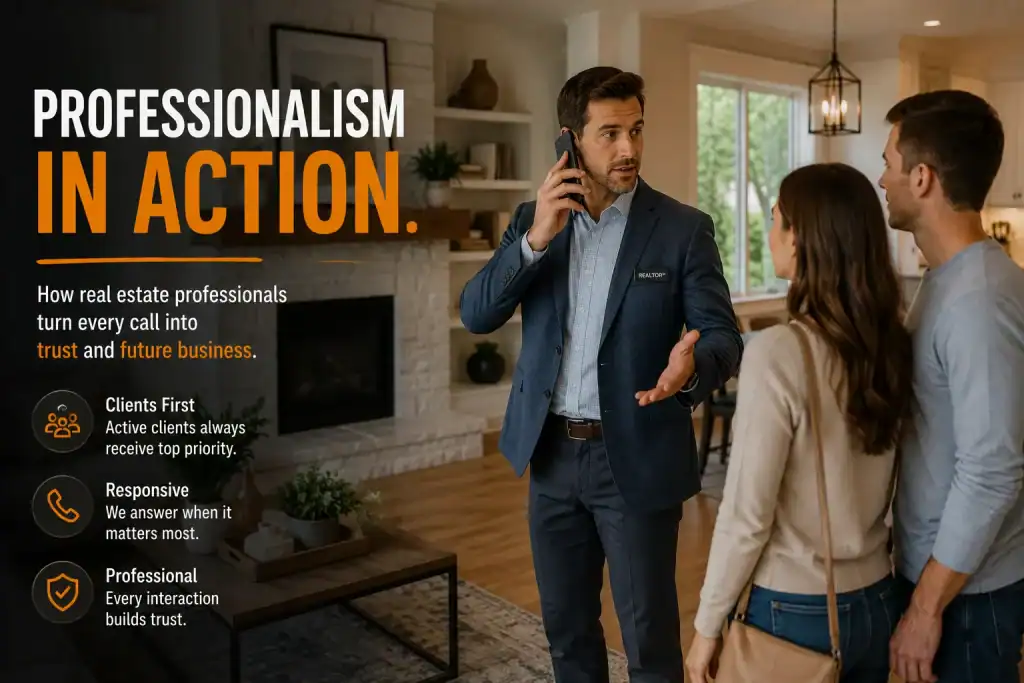
The Lesson Every Professional Learns
During my years teaching high school and coaching basketball, I learned something that had absolutely nothing to do with jump shots, history, or lesson plans.
People are always watching.
My players watched how I treated the last player who made a mistake.
My students watched how I handled the class clown.
Parents watched how I communicated when things weren't going well.
And in real estate...
Your future clients are watching how you treat your current ones.
That's why I never viewed answering the phone as an interruption.
I viewed it as an opportunity to quietly demonstrate my standards.
Not talk about them.
Demonstrate them.
💡 Learning Point
Clients don't hire agents simply because they say the right things.
They hire professionals whose actions consistently match their words.
Expected Outcomes
If you begin treating every phone call as an opportunity to demonstrate your professionalism instead of an interruption, several things begin to happen naturally.
- ✅ Clients become more confident in your ability to represent them.
- ✅ Expectations are established early instead of after problems arise.
- ✅ Trust begins to develop long before contracts are signed.
- ✅ Existing clients know they remain your highest priority throughout the transaction.
- ✅ Prospective clients see exactly how they'll be treated when it's their turn.
Best Practices
- 📱 Answer your phone whenever reasonably possible.
- 🤝 Never make an active client feel like they're competing for your attention.
- 🕒 If you can't talk, acknowledge the call and establish a realistic expectation for your return call.
- 🎯 Use professionalism to educate prospective clients through your actions.
- 🏆 Remember that every interaction is building, or damaging, your reputation.
Coach's Challenge
For the next seven days, stop thinking about your phone as a communication device.
Instead, think of it as a window into your professionalism.
Every time it rings, ask yourself one simple question:
“What would a true professional do in this situation?”
If you consistently answer that question honestly, and act on it, you'll discover something remarkable.
Professionalism isn't one big decision.
It's hundreds of small decisions repeated consistently.
Key Takeaways
- Professionalism is demonstrated through actions, not marketing.
- Your fiduciary responsibility belongs first to the clients you've already committed to represent.
- Managing expectations is one of the most valuable services you provide.
- Future clients are always watching how you treat current clients.
- Professionalism earns trust. Trust builds business.
📚 Classroom Assignment
This week, pay attention to every phone call you receive.
Don't ask yourself whether you answered it.
Ask yourself whether your actions reinforced the level of professionalism you want clients to remember.
Professionalism earns trust.
Trust builds business.
This Is The Standard Members Receive Every Week
This lesson was not written to entertain you for three minutes and disappear. It was built to teach a professional habit you can actually use with clients, prospects, and active transactions.
Why This Is Quality Content
Every INVISIQ lesson is designed as practical professional development, not recycled motivation or generic real estate advice.
- It teaches behavior, not slogans. You are shown what to do, what to say, and why it matters.
- It is built around real client situations. The lesson connects professionalism to active transactions, fiduciary responsibility, trust, and reputation.
- It includes usable scripts and examples. Members receive language they can adapt immediately in the field.
- It ends with action. Expected outcomes, best practices, coaching challenges, takeaways, and assignments turn the lesson into applied training.
Produced By INVISIQ
INVISIQ real estate training is produced from the perspective of a former teacher, coach, real estate professional, and investor who believes professionalism is demonstrated through consistent action. The goal is simple: help agents and investors build businesses people can trust.
Become a Professional Member for $12.99/month.
Become a Professional MemberGet weekly real estate professionalism lessons, practical scripts, coaching challenges, and member-only training content.
INVISIQ helps real estate agents and investors build professional businesses through practical real estate training, client communication lessons, fiduciary responsibility awareness, trust-building habits, and weekly professional development content.
Download The Client Call Framework Handout
The lesson above explains why answering your phone matters. This free handout gives you a practical framework for what to say when the phone rings during real-world client situations.
What This Handout Helps You Do
- Handle calls during showing appointments without making the person in front of you feel ignored.
- Handle calls during closings with the higher level of care those moments require.
- Separate urgent calls from routine calls without guessing or overreacting.
- Use professional language that protects trust on both sides of the conversation.
- Demonstrate your standard of service instead of merely claiming you provide it.
Why It Is Worth Saving
This is not a generic checklist. It was created as a companion tool to an INVISIQ professional training lesson, using the same practical teaching format: real scenarios, clear scripts, client expectations, and action steps agents can apply immediately.
Opens in a separate browser tab so you can keep the lesson open while reviewing the handout.
Free real estate client communication handout from INVISIQ: a practical phone call framework for real estate agents handling client calls during showing appointments, closings, active transactions, and professional service conversations.
How AI Can Help You Practice This Lesson
There is growing fatigue around artificial intelligence, and frankly, some of it is deserved. A lot of AI content is lazy, generic, and overhyped.
But professionals do not make decisions based on irritation, hype, fear, or emotion. Professionals look at the facts, test the tool, and decide whether it helps them perform better.
The Professional Standard
AI should not replace your judgment, your voice, your ethics, or your responsibility to the client.
Used poorly, AI creates slop.
Used professionally, AI can become a practice partner that helps you rehearse difficult conversations before the real moment arrives.
We are the carpenters. AI is just one tool in the toolbox.
Copy And Paste These Practice Prompts Into Any Public AI Tool
Use these prompts with ChatGPT, Claude, Gemini, Copilot, Perplexity, or another public AI tool. The goal is not to have AI write your personality for you. The goal is to practice your professional response before a client puts you on the spot.
Act as a prospective homebuyer meeting me at a showing appointment. During our conversation, my phone rings from an active client who is currently under contract. Roleplay the situation with me. After I respond, evaluate whether I protected the person in front of me, respected the active client, and demonstrated professionalism.
Act as a client who is currently under contract and calling me while I am meeting with another client. Start with a realistic concern that may or may not be urgent. Let me respond as the agent. After the roleplay, tell me whether I asked the right questions, managed expectations clearly, and avoided sounding dismissive.
Act as a real estate client calling me while I am at a closing with another client. Create a realistic issue and let me decide whether to answer, defer, or briefly respond. Afterward, grade my response on professionalism, timing, clarity, client trust, and whether I respected the importance of the closing.
Use AI Like A Professional
- Do not copy AI responses blindly.
- Do not let AI replace your judgment.
- Do not use AI to sound polished but empty.
- Use AI to rehearse, pressure-test, and improve your own professional language.
- The final standard is still you, not the tool.
INVISIQ uses AI practice prompts as real estate professional development tools: roleplay prompts for client communication, showing appointment interruptions, closing appointment phone calls, active transaction conversations, expectation management, and trust-building practice for real estate agents and investors.
⭐ How Did We Do?
Was this lesson valuable?
Leave a comment below and share how you've handled phone calls during active transactions. Your experience may help another real estate professional become better at what they do.